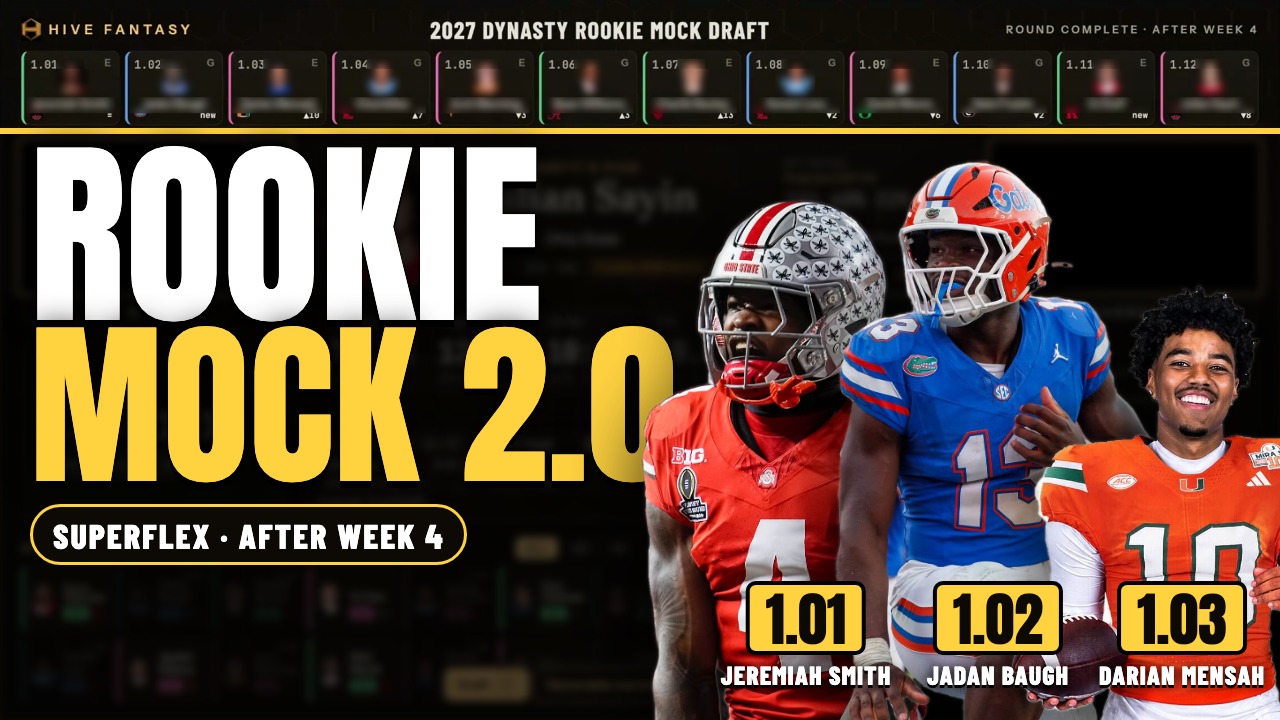
Four weeks of college football reshuffled our 2027 SuperFlex first round. We re-drafted it pick by pick after Week 4: who climbed, who slipped, and the numbers behind every selection.
Four weeks of college football are in the books, and our 2027 board already looks different. So we sat back down after Week 4 and re-drafted the first round of our SuperFlex rookie mock from scratch, alternating picks like a real draft. Ethan won the coin flip, so E took every odd slot and Garrett took every even one.
Here's the short version of what changed since Mock 1.
The first two quarterbacks off our board weren't in our June top ten. Darian Mensah went 1.03 and Trinidad Chambliss went 1.04. Arch Manning, Dante Moore, and Julian Sayin all slid, and Sayin barely held on at 1.12.
Two first-rounders weren't anywhere in our first two rounds in June. Jadan Baugh went 1.02. KJ Duff went 1.11. That one's on us.
Four names fell out of round one entirely: Cam Coleman, Bryant Wesco Jr., Ryan Wingo, and Ahmad Hardy.
Watch the full re-draft on YouTube: 2027 SuperFlex Rookie Mock Draft 2.0. Every pick below has who made it, the case they made on air, a box-score stat line through Week 4, and how far the player moved from Mock 1.
One housekeeping note: the Mock 1 slots below track the two rounds we drafted on camera in June, which ran a little differently from the 48-pick written Mock 1.
| Pick | Player | Pos | School | Drafted by | Mock 1 | Move |
|---|---|---|---|---|---|---|
| 1.01 | Jeremiah Smith | WR | Ohio State | Ethan | 1.01 | 0 |
| 1.02 | Jadan Baugh | RB | Florida | Garrett | Not drafted | New |
| 1.03 | Darian Mensah | QB | Miami | Ethan | 2.01 | +10 |
| 1.04 | Trinidad Chambliss | QB | Ole Miss | Garrett | 1.11 | +7 |
| 1.05 | Arch Manning | QB | Texas | Ethan | 1.02 | -3 |
| 1.06 | Ryan Williams | WR | Alabama | Garrett | 1.09 | +3 |
| 1.07 | Charlie Becker | WR | Indiana | Ethan | 2.08 | +13 |
| 1.08 | Kewan Lacy | RB | Ole Miss | Garrett | 1.06 | -2 |
| 1.09 | Dante Moore | QB | Oregon | Ethan | 1.03 | -6 |
| 1.10 | Nate Frazier | RB | Georgia | Garrett | 1.08 | -2 |
| 1.11 | KJ Duff | WR | Rutgers | Ethan | Not drafted | New |
| 1.12 | Julian Sayin | QB | Ohio State | Garrett | 1.04 | -8 |
Five quarterbacks, four receivers, three running backs. In June it was four quarterbacks, five receivers, and three backs. One receiver slot became a quarterback slot, which is about what you'd expect in SuperFlex once a couple of passers start playing like first-rounders.
Ethan's pick. E called it the easiest pick of the draft, and nobody is going to argue. His case: even in SuperFlex, Smith is the player dynasty managers are tanking for this season, and the Illinois game was outrageous. Garrett piled on. Our database comp is Julio Jones, and Garrett called him maybe the best receiver prospect since Calvin Johnson. Through four games he's averaging over 150 receiving yards a game, and he just dropped 217 and four touchdowns on Illinois.
Through Week 4: 33 catches, 617 yards, 7 TD in 4 games. Mock 1: 1.01, no change.
Garrett's pick, and a surprise even to him. Heading into the season, Garrett fully expected 1.02 to be a quarterback. Four weeks changed that. His case is simple: Baugh has been the best running back in college football, and he's too good to pass up here. The production backs it up. Eleven touchdowns in four games, 7.2 yards a carry, and three scores in each of his two SEC games, including 29 carries for 142 yards against Ole Miss.
Running backs drafted 1.01 to 1.06 have returned a hit season 73% of the time in our study (n=22). That's the best rate of any position with a real sample in that range. Baugh's database comp is Joe Mixon, and a three-down back with his frame is exactly the profile that rate is built on.
Owning the miss: Baugh wasn't in the two rounds we drafted on camera for Mock 1. As Garrett put it on air, we all make mistakes.
Through Week 4: 83 carries, 600 yards (7.2 per carry), 11 TD; 2 catches, 18 yards. Mock 1: not drafted. New to round one.
Ethan's pick. E's favorite quarterback in the class, and he admitted it runs a little against consensus. His case is experience. Mensah has a ton of it, he's come to Miami and just thrown the ball around, and E expects his composure to show once the bigger games arrive. If it does, he thinks the draft stock really starts climbing.
Garrett's pushback was fair: we haven't seen Mensah tested by a quality Power 4 defense yet. Stanford and Wake Forest technically count, but neither is a high-quality unit. The supporting cast is real, though, with Malachi Toney and friends around him.
An 88.7% completion rate with zero interceptions. That's the line through four games. Small sample, soft schedule, still absurd.
Through Week 4: 94 of 106 (88.7%), 1,211 yards, 14 TD, 0 INT, 11.4 yards per attempt; 1 rushing TD. Mock 1: 2.01, up 10.
Garrett's pick. He was stumped on the clock, then went quarterback: the undersized, underrated Chambliss. Garrett's case is that he doesn't have every physical tool a GM might want, but he has what matters most, which is what's between the ears. He's sharp, he reads defenses, he has a quick release, and he has sneaky athleticism. The comp is Russell Wilson, and Garrett thinks he'll be a real value in rookie drafts next year.
Ethan added the schedule context people are missing. Three of Ole Miss's first four games were Louisville, LSU, and Florida. The Florida game was a tough loss, but Chambliss went into LSU with a chip on his shoulder and delivered: 363 passing yards, two touchdowns through the air, and one on the ground.
Through Week 4: 70.8% completions, 1,222 yards, 8 TD, 3 INT, 8.5 yards per attempt; 4 rushing TD. Mock 1: 1.11, up 7.
Ethan's pick. E's case: Manning is probably the first quarterback off the board in the NFL Draft. He'll admit there have been games where the accuracy isn't there and the decision-making is a little off, and he knows we're both lower on Arch than consensus. But you can't deny the tools. E sees enough dual-threat ability to matter at the next level, the way the Trevor Lawrences, Patrick Mahomeses, and Josh Allens of the world pick up yards with their legs.
Garrett gave him grief for taking the next Daniel Jones at 1.05 (our database comp, for what it's worth). All jokes aside, his point was that Manning is an insulated prospect. As long as he doesn't fall apart the rest of the year, the name brand alone should land him strong NFL draft capital.
The rushing piece is the part to watch. He ran for 8 touchdowns in 2025 and has zero through four games this year.
Through Week 4: 73 of 115 (63.5%), 862 yards, 7 TD, 3 INT, 7.5 yards per attempt; 0 rushing TD. Mock 1: 1.02, down 3.
Garrett's pick. He went receiver, and it's the other super-talented freshman from two years ago. Garrett's case: Williams has looked so much better with Keelan Russell at quarterback, and he's got his mojo back. In Garrett's read, the drops, always the biggest concern, are way down, and he looks explosive again, making big plays and catching touchdowns. Garrett thinks he builds on the momentum and ends up a first-round pick next year.
Ethan's add: people forget how talented Williams was as a 17-year-old. He's not even 20 yet, he's still developing, and some swagger goes a long way.
Nearly 20 yards a catch. He's at 19.6 per reception, including 98 yards and two scores in the South Carolina win.
Through Week 4: 17 catches, 333 yards, 3 TD in 4 games. Mock 1: 1.09, up 3.
Ethan's pick. E knows this is higher than some people will have him. Every Indiana game he watches, Becker is the go-to guy. You can't cover him one-on-one; even when the coverage is glued to him, he wins. E, a Northwestern fan, watched Indiana's 29-23 win over the Wildcats, and Indiana just kept flicking it to Becker. He finished with 7 catches for 98 yards.
Garrett's add: our database comp is Christian Watson. The strides are long, he's fast and athletic, he high-points the ball, and the route running is developing.
Receivers drafted 1.07 to 1.12 have hit more often in our study than receivers drafted 1.01 to 1.06: 68% to 52%. (n=28 and n=21, 1+ hit season.) Late-first receivers like Becker are not a consolation prize.
Through Week 4: 19 catches, 370 yards, 6 TD in 4 games; 73% catch rate. Mock 1: 2.08, up 13. The biggest climber on the board.
Garrett's pick. With some good backs still on the board, Garrett couldn't pass on Lacy. He's been banged up, but when he's been out there he's still been very good. Garrett's case leaned on the game Lacy missed. Ole Miss clearly missed him against Florida: the Gators established the run with Baugh, Ole Miss didn't have an answer, and couldn't hold the ball the way Florida did.
To be precise about the injury: through Week 4, Lacy has played three of Ole Miss's four games and sat out the Florida loss. Garrett also mentioned Ahmad Hardy as the other back he'd put at the top of the class with Lacy. Hardy hasn't played yet in 2026 (more in the fallers section).
Through Week 4: 39 carries, 191 yards (4.9 per carry), 4 TD; 7 catches, 16 yards, in 3 games. Mock 1: 1.06, down 2.
Ethan's pick, and a late audible. E flipped from what he had in mind, partly because this class is deep enough that from 1.02 on down you could argue for almost anybody. His case is experience. We've seen that college reps can carry over to the NFL, and Brock Purdy is the example E reached for. He thinks our Bo Nix comp is a great one: athletic enough to outrun defensive linemen and make plays on his feet, with enough accuracy and zip to make the tough throws.
The caveats were on the table too. Moore took a scary hit against USC, and E hopes there are no lasting effects. The Oklahoma State loss wasn't his high point either: 14 of 29 for 191 yards. Garrett's reply: he just wants to see Moore back out there healthy and balling.
Through Week 4: 69.7% completions, 926 yards, 9 TD, 0 INT, 9.4 yards per attempt. Mock 1: 1.03, down 6.
Garrett's pick. Back to the running back well, and Garrett admitted he's learning something about himself. Frazier is another back who's a little banged up right now, but he's been incredibly explosive. Garrett's case is the touchdown-to-touch ratio: it feels like every time he touches the ball it's a big play or a score. He's predicting a 4.3 at the combine, and with the Georgia pedigree he sees another James Cook or Kenneth Walker type (Walker is our database comp).
Ethan agreed: eight yards a carry is insane at any level of football, and Georgia knows how to make running backs. He sees Frazier getting playing time right away at the next level.
Five touchdowns on 25 touches. That's the ratio Garrett was talking about.
Through Week 4: 24 carries, 202 yards (8.4 per carry), 5 TD; 1 catch, 5 yards, in 3 games. Mock 1: 1.08, down 2.
Ethan's pick. E went with a player who wasn't really on our radar going into the season. Duff is a huge body at 6-foot-6 and 225 pounds who passes the eye test. E knows the competition hasn't been elite, but Rutgers's 42-35 loss to USC was closer than people expected, and Duff was one of the main reasons. E thinks plenty of NFL GMs will be interested.
Garrett's add: over four yards per route run and seven touchdowns on 29 catches is absurd. The question now is how Duff handles defenses keying on him, because he's clearly Rutgers's most talented player.
Through Week 4: 29 catches, 550 yards (19.0 per catch), 7 TD in 4 games. Mock 1: not drafted. New to round one.
Garrett's pick. Back to quarterback to close the round, with a few options in play. Drew Mestemaker has looked pretty good, but Garrett is pegging him as a 2028 prospect: he's still young, he already has five interceptions, and he could benefit from another season. That left Sayin or CJ Carr. Garrett knows it's close for a lot of people, but his preference is Sayin. Sayin gets dog-piled because he has all the weapons, including Jeremiah Smith, and hasn't won a national title with them yet. Garrett thinks he's a stud and a very smart player, and our database comp is Brock Purdy.
One flag to carry with him: Sayin is a possible 2028 declare.
Through Week 4: 72.2% completions, 1,206 yards, 10 TD, 1 INT, 10.5 yards per attempt; 2 rushing TD. Mock 1: 1.04, down 8.
Ethan's take on the list below: plenty of these players could swap in for the last few picks of round one, depending on your roster holes. If your league is tight end premium, that changes the strategy too. His bigger point is about the market. Everybody is chasing 2027 firsts, and 2027 seconds are still cheap to throw into trades, even though you can see how much talent is still on the board in round two.
Garrett took it one step further: there are huge tiers in this class. Compare the second or third pick to the end of round two and the gap isn't as big as the price tag suggests. He even likes stockpiling thirds.
Mark my words, there's gonna be some steals that get drafted in the third, fourth, or maybe even undrafted in rookie drafts.Garrett, on the depth of the 2027 class
Our study says a third-round pick has hit more often than a late second. Picks in round three returned a 1+ hit season 22.7% of the time. Picks at 2.07 to 2.12 did it 19.7% of the time. Round three wins at 2+ and 3+ as well.
Here's who just missed the cut, with their numbers through Week 4.
| Player | Pos | School | Through Week 4 |
|---|---|---|---|
| CJ Carr | QB | Notre Dame | 963 yds, 9 TD, 1 INT, 70.5%; 2 rush TD (4 g) |
| Drew Mestemaker | QB | Oklahoma State | 1,271 yds, 11 TD, 5 INT, 67.4%; 1 rush TD (4 g) |
| Jayden Maiava | QB | USC | 1,499 yds, 14 TD, 2 INT, 70.1%; 2 rush TD (5 g) |
| Mark Fletcher Jr. | RB | Miami | 36 car, 230 yds, 6.4 ypc, 3 TD (3 g) |
| Justice Haynes | RB | Georgia Tech | 73 car, 393 yds, 5.4 ypc; 11 rec, 47 yds; 5 TD (4 g) |
| Ahmad Hardy | RB | Missouri | Has not played in 2026 |
| Cam Coleman | WR | Texas | 12 rec, 208 yds, 4 TD (4 g) |
| Ryan Wingo | WR | Texas | 19 rec, 239 yds, 2 TD (4 g) |
| Nick Marsh | WR | Indiana | 16 rec, 221 yds, 3 TD (4 g) |
| Deuce Alexander | WR | Ole Miss | 27 rec, 429 yds, 4 TD (4 g) |
| Wyatt Young | WR | Oklahoma State | 22 rec, 410 yds, 3 TD (4 g) |
| Reed Harris | WR | Arizona State | 19 rec, 374 yds, 5 TD (3 g) |
| Trey'Dez Green | TE | LSU | 14 rec, 222 yds, 1 TD (3 g) |
| Jamari Johnson | TE | Oregon | 11 rec, 176 yds, 1 TD (2 g) |
| Luke Reynolds | TE | Virginia Tech | 30 rec, 280 yds, 4 TD (4 g) |
A few notes on the list.
The quarterbacks Garrett passed on at 1.12. Carr and Mestemaker were both in the conversation for the last pick of the round. Garrett pegs Mestemaker as a 2028 prospect, and both carry a possible 2028 declare flag on our board, same as Sayin. Between Carr and Sayin, it came down to personal preference.
The tight ends, if your league is TE premium. Green, Johnson, and Reynolds are the names that jump in that format. In our study, third-round tight ends returned a 1+ hit season 38% of the time (n=16), nearly double the rate for third-round running backs and receivers (20% each). Small sample, but it points the same direction E did.
New names on our radar. Deuce Alexander, Wyatt Young, Reed Harris, and Drew Mestemaker weren't on our original 48-player 2027 board. Four weeks of tape put them on it.
Ethan made the point that ties the first four together: every one of them entered the season with a question mark. Becker had Nick Marsh transferring into his room. Mensah had to prove it at Miami against a higher level of competition. Chambliss had to show last year wasn't a one-hit wonder. Williams was coming off a down year. All four have answered so far, and if they keep performing at this level, E thinks they'll trend even higher.
Baugh and Duff are the two we flat-out missed in June. Baugh went from outside our first two rounds all the way to 1.02. Duff went from outside our first two rounds to the end of the first. We'll see if they sustain the hot starts.
If you're playing as expected, guys who are outperforming expectation kind of pass them a little bit.Ethan, on the quarterback fallers
That's E's read on Sayin, Moore, and Arch. In his view, all three are playing about as expected. A couple of other quarterbacks have outperformed expectations, and that's enough to get passed.
Where a quarterback lands inside round one matters more than at any other position in our study. Quarterbacks drafted 1.01 to 1.06 returned a top-12 season 68% of the time (n=22). Quarterbacks drafted 1.07 to 1.12 did it 38% of the time (n=13). That's a 30-point drop, the steepest of any position. Some of that is the market correctly sorting who goes early. Either way, Moore and Sayin now sit in the range where history has been far less kind.
That's our first round after four weeks, and none of it is locked. The QB order has already flipped once, two backs we didn't draft in June are first-rounders now, and there's a whole lot of football left.
Two things to do while you wait for the next one. First, check where your picks actually land: the Hit Rate Tool shows how often every draft range has paid off over twelve years, by position. That's the same data behind every number in this article. Second, keep an eye on the site. We're building a free mock draft tool, and it's coming to the site soon.
The full 48-player board lives at the 2027 draft board, with deep dives on the 2027 prospect profiles. And if you disagree with a pick, good. Tell us in the comments on the video. We like to go against consensus sometimes, too.
